




They stayed sober by serving others.
Words by Steven Henke • Photos by Demarcus O’Dell
Vintage photos courtesy of Thom Muller
At first glance, the manila envelope seemed ordinary.
It was a cool May morning in Palm Springs, and I was sitting in Thom Muller’s kitchen, a man I had known for years after first meeting him at a 7:00 a.m. Alcoholics Anonymous meeting at Sunny Dunes, exchanging greetings and listening to his shares without ever fully knowing his story. That changed when he mentioned, almost in passing, his early days volunteering with Desert AIDS Project, a conversation that eventually led me here, to his table.
As he carefully emptied the envelope onto the surface, out of it flowed evidence from another life: old photographs, HIV testing certifications from the 1990s, an award for having given 1,000 volunteer hours, and DAP name badges illustrating the many roles he held in the organization’s early days. Spread across the table, the objects hinted at the beginnings of something larger than a store — what people today know as Revivals: a place, a community, and a source of purpose.
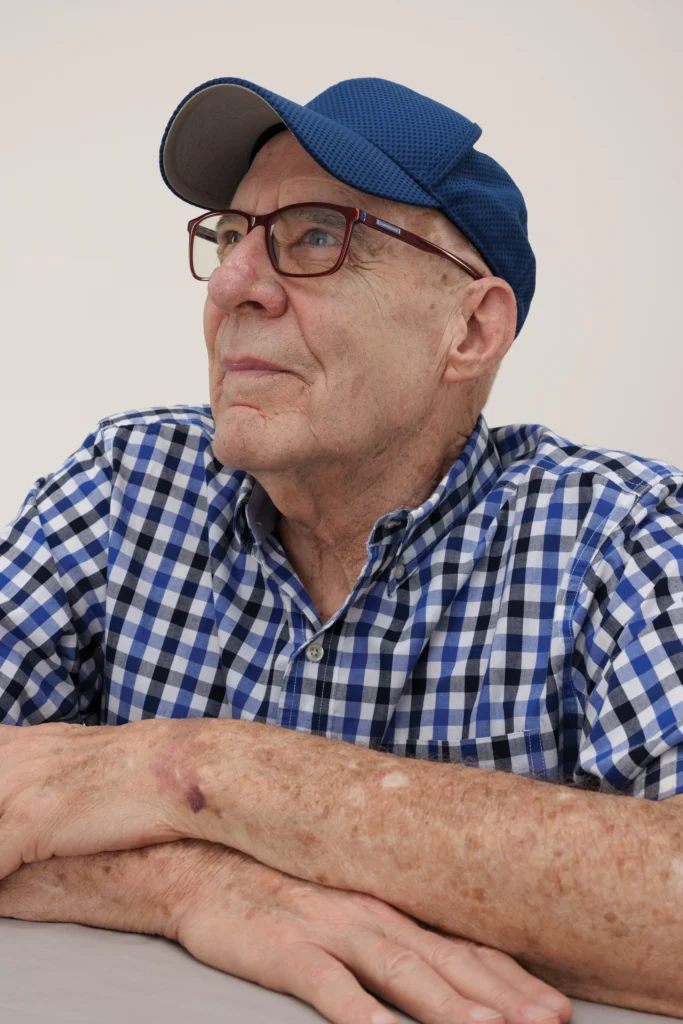
Muller speaks plainly, without claiming credit. More than three decades in Alcoholics Anonymous have taught him a simple discipline: service. It helped him get sober, and it helped him stay there.
That is where this story begins, not with a thrift store, but with a principle learned in recovery. “Be of service,” Muller says. “Not just in the rooms. Be of service outside the rooms.” That instruction would help spark one of the Coachella Valley’s most successful nonprofit retail enterprises.
A step back in time
When Muller got sober in the early 1990s, he was 40 years old, and the HIV/AIDS epidemic had already reshaped his life. Friends in Colorado had died. In Palm Springs, the crisis was still raging, and DAP needed volunteers.
In fact, the nonprofit itself was still taking shape when Muller joined as an HIV testing volunteer. Two nights a week, he sat with people in two small offices at the back of The Desert Sun’s offices on North Palm Canyon Drive, part of what is now the Revivals Palm Springs store.
Together, he and the men he served would wait for answers during one of the most frightening periods of the epidemic. “People were scared and uninformed,” Muller recalls. “They had no idea where this was headed.” There were no effective treatments. AZT had appeared, but it offered little hope. Entire circles of friends were disappearing.
By today’s standards, the entire process was brutal. People had to wait two weeks for results. When they came back, Muller learned them at the same moment the men did. “We would open the envelope together,” he remembers. Sometimes, he held a hand. Sometimes, someone cried. Sometimes, fear manifested as anger. Each envelope had the potential to carry a life-changing answer.
Curing isolation
For those who tested positive, DAP offered what medicine often could not yet provide: dignity, compassion, and the assurance that no one would face the disease alone. But even that compassion existed in a climate of fear and stigma. Who wanted to be associated with AIDS?
“People wouldn’t give money. They didn’t want to touch it,” says Craig Prater today. Back then, he was the development director at DAP. He remembers going before the Palm Springs City Council repeatedly to ask for support, without any success. “It was hands-off.”
Clients, too, carried fear into every interaction. For some, simply entering the DAP building felt dangerous. Prater recalls that Hispanic men who were married to women but needed the agency’s services — what today we would call men “on the down low” — were terrified of being discovered there. “It was very secretive,” he says. Case managers sometimes arranged private appointments when the building was closed, allowing clients to receive care without sacrificing privacy.
Thankfully, there were also people who moved toward the crisis instead of away from it. Prater never forgot one group. “Nuns,” he says. “They went to the hospital when even parents wouldn’t go. They weren’t afraid to touch these men.”
The birth of Revivals
At the same time, another effort was taking shape in a storage room. Community members began donating clothing, furniture, books, canned goods, and household items. Some wanted to help people living with HIV/AIDS. Others were grieving lost loved ones and wanted their belongings to serve some purpose. First, the donations were stored at DAP’s Vella Road location, where clients could take what they needed.
When funding to expand medical services finally arrived, that storage room had to become clinical space. So, Muller and Jack Kunkel moved the donations to the front lawn and started selling them on the weekends. The money helped support counseling and testing. There was no business plan, just a need, and volunteers were willing to meet it.

The yard sales caught on quickly. To regulars, the operation would become known as Desert Friends Thrift Shop when it opened its first storefront on Perez Road. Kunkel was the store’s first manager. What made it work was not merchandise, but the volunteers, many of them from Palm Springs’ recovery community. At Sunny Dunes — a young Alcoholics Anonymous meeting that would grow into one of the city’s most influential recovery communities — Muller and others made regular announcements asking for help.
The response was immediate. Newly sober men rebuilding their lives showed up to unload furniture, run registers, and drive their own cars across the valley to pick up donations. Many had seen the HIV/AIDS crisis up close. All understood what Muller learned in recovery: Helping someone else could also help save you. “Every one of them showed up,” says Muller. “Every one of them.”
Among them were Gene Kittredge, Don King, Joe Troutman, and many others still fondly remembered in Palm Springs’ recovery circles. Some were businesspeople, others retirees. Many were mourning people they’d lost. What united them was purpose.
For Muller, the work offered yet another bonus: belonging. “After being selfish for all my drinking and drugging career, I was finally giving something back,” he says.
The thrift shop became a gathering place where grief, recovery, generosity, and hope converged. Volunteers brought their own histories with them, and through the work, found community.
Bargains for the cause
As the thrift shop grew, DAP bought its first truck, then a larger one. Donations increased. Customers came for bargains, for the cause, or both.
The store also promised something more subtle: a way to help without being seen helping. “People could donate things and feel like they were supporting the cause,” Prater explains, “without having to say publicly they were giving to an HIV/AIDS organization. In a time when even association carried stigma, that mattered.”
“When we started getting a thousand dollars a weekend, we knew we had a winner,” adds Muller.

Passing the torch
By the time Muller and Kunkel stepped away, others were carrying the work forward. The thrift shop expanded, evolved, and was eventually renamed Revivals. New leaders brought more sophisticated retail practices, but the foundation stayed the same, built by volunteers who simply showed up. It was shaped by people practicing service, by individuals who gave their time and effort with quiet consistency. At its core were those who understood a deeper truth: that helping others was often the surest path to healing themselves.
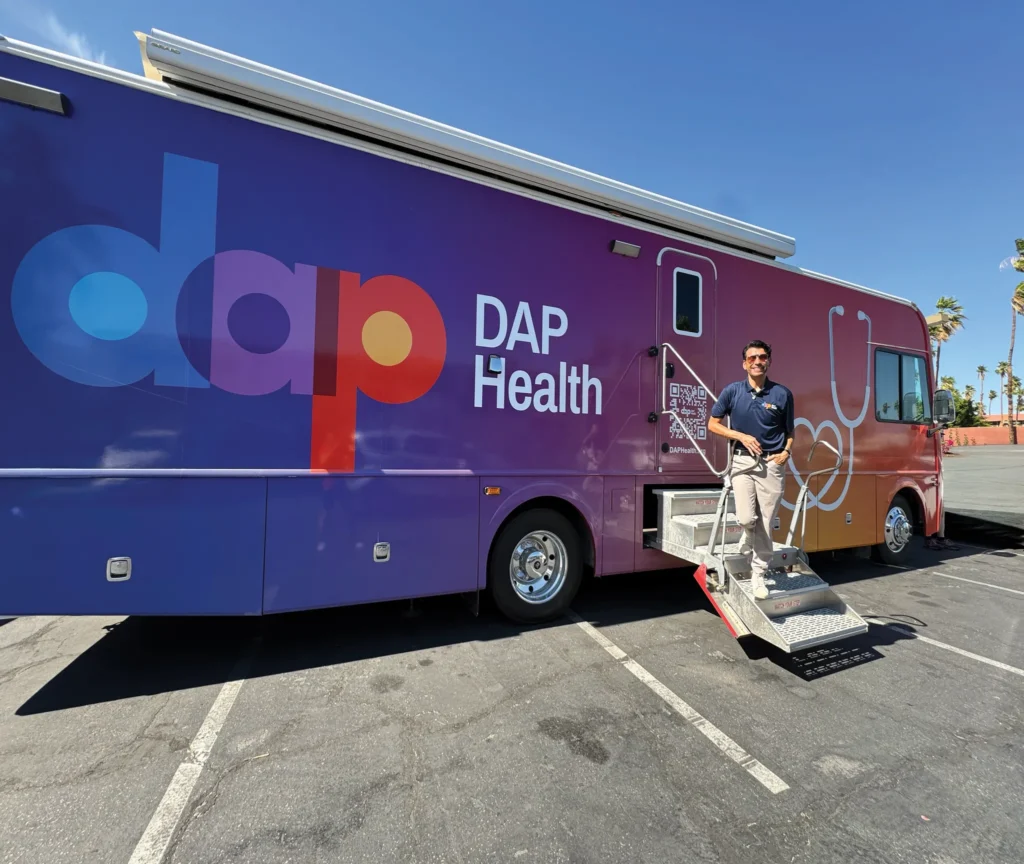
Today, DAP Health serves more than 80,000 patients at 23 clinic locations and six mobile units. Revivals generates nearly $2 million a year to help support its mission of making equity, dignity, and lifesaving care possible, an outcome the volunteers unloading furniture on Vella Road could scarcely have imagined.
When Muller walks into a Revivals store today, he’s less interested in the scale of the operation than in the volunteers behind the counters and on the sales floor. “I see their concern. Their energy. Their desire to be there,” he says. The buildings are bigger now, the mission broader. The spirit, he insists, is the same. “I always say, ‘Thank you for volunteering.’”
Before sliding the photographs and badges back into their envelope, Muller pauses to consider what those early years meant. His answer is simple: People are basically good. When a crisis comes, he says, they step up for one another. In his mind, he was only doing what he’d been taught to do — show up, help somebody, and stay sober. Everything else follows.
CAPTIONS
1. Thom Muller today.
2. (Clockwise from left) First shot: Thom Muller building out the first retail space on Perez Road when it was called Desert Friends Thrift Store. Next three shots: Palm Springs Pride community outreach at Villa Capri Hotel. Last shot: Eddie Dobbs, a Hollywood dresser to the stars, who volunteered in the clothing department at Desert Friends Thrift Store.
3. (Top to bottom) Two first shots: Thom Muller with volunteer John Radiken, who built shelves and displays at the thrift store. Next shot: Thom Muller in the very first truck with a lift used for picking up donations. Prior to that, volunteers were using their own vehicles. Last shot: Jack Kunkell, the manager of Desert Friends Thrift Store.