




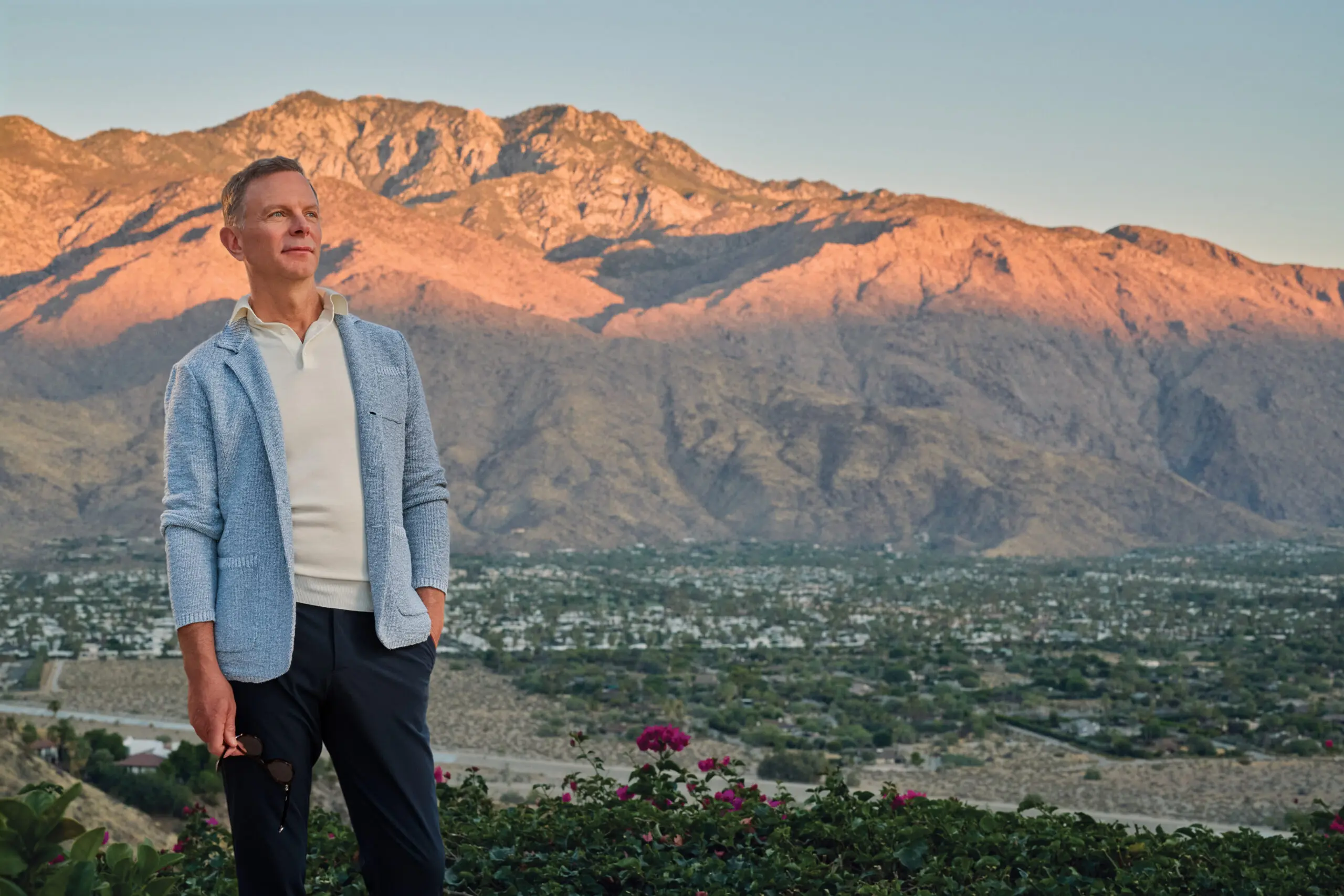
David Brinkman reflects on what his 20 years as DAP Health’s CEO has taught him and why he continues to fight for health care access.
Words by Maggie Downs • Additional reporting by Daniel Vaillancourt
Photos by Brandon Harman and Lani Garfield (please see captions below)

Every weekend, David Brinkman drives from the desert to the coast and dives into the Pacific. A mile out is the minimum. Three miles, if he has the day to give.
The ocean, he’ll tell you, is never boring. The waves shift. The water temperature drops without warning. Marine life appears and disappears. Out there, you must focus on what’s directly in front of you. “There’s no choice but to stay present,” says the 54-year-old.
Brinkman has spent his entire career moving toward problems that would send most other people running in the opposite direction: AIDS, homelessness, poverty, public health crises. He has a knack for reading the currents beneath the surface, the unseen forces that shape people’s lives.
That instinct developed early.
A small-town start

Brinkman grew up in Mason City, Iowa, a fifth-generation resident in a state where differences were conspicuous. Early on, he understood he was gay, but the messages he absorbed about people like him were rarely subtle. “I knew my life was not safe,” he remembers.
When you carry a secret, you become adept at spotting other people carrying theirs. His closest friends were often the kids who also occupied precarious positions in the social order: students of color, kids who were mocked, those who understood what it felt like to enter a room already at a disadvantage. “I identified with their struggle because I was having that same struggle,” he recalls. “Yet it was completely in silence.”
At 14, Brinkman left Iowa for boarding school outside Minneapolis, then later attended Lewis & Clark College in Portland, Oregon. He chose the school partly because of its environmental law program. “I thought, if they care about the environment, they’re going to care about human rights issues, and I’ll be safe here,” he says.
At Lewis & Clark, he majored in sociology and anthropology, minored in gender studies, and led the student LGBTQ organization. Then, on a visit home from school, he had his first panic attack. “My heart started racing at lunch,” he remembers. “I started sweating.”
A higher purpose is hereditary
His parents — an endocrinologist father and registered nurse mother — recognized immediately that something deeper was happening in their son. Brinkman remembers finally articulating the fear that had been bubbling under. “I didn’t take time to process what was going on. I simply said, ‘There is a disease that is killing my community, and it will eventually kill me sooner than later.’”
This was the early 1990s. Effective HIV treatments had not yet arrived. For many gay men, the future felt less like a plan than a grim statistical probability. But what happened next became one of the defining conversations of Brinkman’s life.
“Parents are protective by nature,” he says. “Mine could have easily said, ‘Be celibate, become a priest.’ They could have said anything. But what they said stemmed from why they felt compelled to be of service with their lives.”
Their advice was simple: Go to the front lines. “That was the permission I needed,” Brinkman recalls.
Entering the fray to fight the epidemic

The only open position at Portland’s Cascade AIDS Project was that of “condom fairy” (AKA community health outreach worker), whose sole duty would be the distribution of safer-sex supplies. Brinkman’s enthusiasm got him the gig.
Equipped with a fanny pack filled with condoms, lubricant, and educational materials, he spent afternoons in parks, evenings in bars, and late nights in bathhouses — sheathed in nothing but a white towel — talking to strangers about HIV prevention.
From there, he was quickly promoted to case management. With two or three clients dying each week, the grief accumulated faster than it could be carried.
When Brinkman finally acknowledged the toll, he approached the executive director, Susan Stoltenberg, expecting a difficult conversation. Instead, she redirected his future. Seeing skills he did not yet recognize, she encouraged him to move into fundraising. More importantly, he learned that philanthropy, when done well, is not really about money. It’s about transforming compassion into action.
Stoltenberg proceeded to teach Brinkman the ropes, then accompanied him to benefits at wealthy gay men’s homes, from where together they watched the donations come pouring in.
The call of Southern California
Years later, Brinkman earned his MBA from Pepperdine University’s Graziadio Business School in Los Angeles and went on to lead My Friend’s Place, a nonprofit serving homeless youth on Hollywood Boulevard. “The need was so great, it was hard to feel that you could ever make a change,” he recalls. But somehow, over four years as executive director, he did.

As fulfilled as he was in L.A., when the executive director position opened at Desert AIDS Project in Palm Springs, Brinkman felt the alignment immediately. Something about this job was different.
Susan Unger — who first met Brinkman during his interviews for the position in 2006 while she served on the organization’s board of directors, then stepped away for a few years, and has since returned — remembers an unusually strong reaction. Brinkman was younger than many candidates, but she came away convinced DAP needed to find a place for him.
“We can’t let this guy get away,” she remembers thinking. What struck her was Brinkman’s direction. He arrived prepared, with a focused sense of how his life and work had led him there. “It was just clear he had a lot to offer.”

It was at his fifth “audition” dinner with the board that a member questioned their responsibility to write personal checks to DAP. Brinkman categorically stated he believed members of the community would only make contributions to the nonprofit if they firmly understood the board was similarly invested — that each of its members had skin in the game. “If you don’t believe in that,” Brinkman told the board, “then I’m not the executive director for you.”
“David started on August 1, 2006,” recalls longtime board member Kevin Bass. “Not only has he made good on the promise that was clearly on display during his hiring process, but he has also surpassed all our expectations. Under his leadership, the organization has secured hundreds of millions of dollars in public and private investment during the last two decades.”
Building a new model
To understand what Brinkman has helped build in the last 20 years — and how he would like to guide the nonprofit’s future — one must understand what DAP invented during its first decade of existence.
When the organization was founded in 1984, it was the early years of the epidemic. Effective HIV medications were still years away. People were fired for having HIV. Stricken people were evicted from their apartments. The disease exposed weaknesses in nearly every institution that claimed to care for vulnerable people.
Time and again, DAP board members would pose the same question: If this were your brother, your partner, your friend, what else would they need? The answers kept expanding. Medical care, certainly. But also housing. Food. Mental health services. Dental care. Transportation. Basic human dignity.
What emerged was not simply an AIDS service organization but a philosophy of care. Long before phrases like social drivers of health entered mainstream health care vocabulary, DAP was operating as if they were self-evident. “That is the silver lining of the HIV/AIDS crisis,” Brinkman says.
By the time the Affordable Care Act created a pathway for organizations like DAP to become federally qualified health centers, Brinkman understood where health care was headed. The future, as he saw it, required treating whole lives rather than isolated symptoms.
Multiplying access to care
In 2023, DAP Health pulled off the most ambitious expansion it has ever attempted when it successfully competed against several much larger entities to acquire the failing, fraud-riddled community health center network then known as Borrego Health.

Overnight, Brinkman went from overseeing 250 team members caring for some 10,000 patients annually at a handful of clinics to leading almost 1,000 health care professionals and support and admin staff with almost 80,000 patients under their care at 23 locations and a half-dozen mobile units.
The absorption not only greatly increased the reach of DAP Health’s dental and mobile health efforts, but brought such new disciplines as pediatrics, OB-GYN, and pharmacy services to the fold. The same model developed during the HIV/AIDS epidemic could now be applied to broader populations: straight cisgender women, children, farmworkers, refugees, unhoused individuals, low-income families, and anyone else whose health was shaped by forces extending beyond an exam room.
“We’ve gone from being a single-mission nonprofit to becoming one of California’s largest community health center networks,” says Bass, “and today we continue to protect and expand access to care for almost 80,000 patients throughout Riverside and San Diego counties. Like every other expansion we’ve accomplished, this one required successful fundraising, government partnerships, regulatory approvals, and operational oversight. I honestly don’t believe DAP Health would be the massive safety net it is today without David’s colossal vision and expert guidance.”
The acquisition was not without risk — or detractors — with many worried that DAP Health was biting off more than it would be able to chew. After all, the agency was inheriting facilities that by and large were in major need of stabilization, both physical and philosophical. Distant communities unaware of the DAP Health brand’s track record were uncertain how or even if their care would be assured. And perhaps most importantly, there were two very different teams whose unique cultures needed to be seamlessly melded.

Corina Velasquez was born in 1984, the year DAP was founded. By 2008, she’d begun serving as a medical assistant at Borrego Health. In 2021, she was named chief operating officer, a title she now holds at DAP Health. “When we were in the process of seeking an acquisitor, there were three things that were fundamentally important to us,” she recalls. “We wanted a mission match. We wanted an organization that would safeguard our team members’ jobs. And we wanted to guarantee our patients would not be left without care. In DAP Health — thanks mainly to David’s direction — we hit the trifecta.
“I have come to learn over the last three and a half years that David leads with heart, presence, and consistency. He does not just talk about mission, he walks it. Whether he’s asking about patient access, team member morale, or what is happening inside our clinics, his work is grounded in a genuine commitment to the people we serve and the people doing the work. I’m very proud to work alongside a CEO who understands that health care is deeply human. David’s ability to remain connected to the mission, visible to the teams, and accountable to the diverse communities we serve is part of what makes his leadership so impactful.”
Meeting those communities where they are
More than three years after the acquisition, DAP Health patients still face a variety of challenges.
In Anza, transportation can be the primary health care obstacle. People live on unpaved roads where rideshare drivers won’t travel.

In Thermal, farmworkers live with the cumulative consequences of decades of physical labor and exposure to groundwater contaminated with arsenic, and some patients speak Purépecha, an Indigenous language from Michoacán, making even Spanish-language services insufficient.
Near San Diego, Chaldean Catholic refugees from Iran often arrive carrying profound trauma after being forced to leave their homes with little warning.
The underlying question, however, remains the same one Desert AIDS Project asked more than 40 years ago: What else do people need? “It is the vision of DAP Health that everybody gets to achieve their full potential in life, no matter who they are,” Brinkman says.
The man loses no sleep over whether every tall hurdle will be overcome. He is confident that every element of “Future Forward,” the 2025 strategic plan he and his executive leadership team devised to map out how to reach their every goal — loosely divided into four areas that focus on advancing health equity, caring for employees, improving patient and client experience, and development resources and partnerships — will see DAP Health across the ambitious finish line.
Looking back, looking forward
Just some of DAP Health’s landmark achievements under Brinkman’s last two decades of leadership include the 80-unit affordable housing complex Vista Sunrise (for people living with HIV) on the nonprofit’s Sunrise campus in Palm Springs, the first adult HIV-specialty dental clinic in Riverside County, and free sexual wellness clinics in Palm Springs and Indio (to eradicate barriers to accessing free STI testing and treatment in the Eastern Coachella Valley).

There have also been official visits to the White House to celebrate the pioneering Get Tested Coachella Valley initiative, and to Africa to talk about DAP Health’s award-winning HIV/AIDS efforts. The Annette Bloch Cancer Care Center was established, and second on-campus affordable housing complex Vista Sunrise II (featuring 60 units for unhoused individuals and those suffering from chronic illness) was opened.
Primed for his next act with not one ounce less of the passion with which he sought the post more than 20 years ago, Brinkman is currently shepherding major advocacy efforts in Washington, D.C., as well as the creation of the DAP Health Foundation to better serve donors of all stripes.
On the footprint expansion front, coming soon are a sexual wellness clinic and pharmacy in Oceanside, which will bring much-needed services to San Diego’s North County, as well as improved infrastructure at DAP Health Sunrise. Currently being built there is a new OB-GYN and primary care space named the Magenta Clinic, plus a fifth DAP Health-owned pharmacy.

Anyone who knows Brinkman understands his compassion and drive know no bounds. Just as he continues to fight for disenfranchised members of the many communities DAP Health serves, he will battle opposing forces on behalf of anyone who turns to DAP Health in their time of need, including immigrants, regardless of their legal status in this country.
“The LGBTQ+ community has always been my community,” Brinkman says. “Today, knowing we are stronger together, my work is to expand access and lift all boats. Health care only works when people can access it. My number one job is to make sure every decision we make helps more people get the care they need, when they need it, and in a way that respects their dignity.”
If that sounds like a Herculean task, it’s because it is. Thankfully, Brinkman is up for it. That’s why on weekends, when he needs to recharge, he goes to the sea. He swims beyond the point where most people would turn around. The water is cold. Conditions change in a heartbeat. The journey can sometimes feel insurmountable. He tackles all this with confident strokes. Then he returns to dry land, ready to resume the important work ahead.
To read issue 7 of DAP Health magazine in it entirety online, please click here.

Timeline
2006
David Brinkman named CEO of Desert AIDS Project August 1.
2007
Vista Sunrise I opens.
2008
The first adult, HIV-specialty dental clinic in Riverside County opens on the DAP campus.
2012
The Annette Bloch Cancer Care Center opens at DAP.
2014
DAP launches Get Tested Coachella Valley as the nation’s first nonprofit-led, region-wide HIV testing, prevention, education, and linkage-to-care initiative.
2015
Sexual wellness clinic The Dock opens at DAP.
2016
The DAP Hepatitis Center of Excellence is established.
2020
DAP opens the first COVID-19 clinic in the desert.
2023
DAP Health acquires Borrego Health.
2024
DAP Health marks 40 years of protecting and expanding health care access for all.
Vista Sunrise II opens.
2025
“Future Forward,” DAP Health’s strategic plan to be implemented over three years, is revealed.
2026
Brinkman celebrates 20 years as CEO of DAP Health on August 1.
Photo Captions
- Brinkman attends his niece’s 2026 graduation with mother Maxine Brinkman and husband Will Grimm.
- Brinkman with Shane Hoffman at Cascade AIDS Project in 1994.
- Brinkman and Grimm in Idyllwild, California.
- Brinkman poses with PS Lola, winner of the 2018 Queen of the Desert pageant, a Desert AIDS Project fundraiser and community event celebrating drag performance, advocacy, and HIV awareness in Palm Springs. Lola went on to become a visible ambassador for the organization and an advocate for people living with HIV.
- Brinkman and philanthropist Annette Bloch dedicate the Barbara Keller LOVE Building on DAP Health’s Sunrise campus, celebrating a major milestone in the organization’s expansion of health care services for the Coachella Valley.
- Brinkman applauds DAP Health team member Maria Elias for sharing her story at the 2025 Steve Chase Humanitarian Awards.
- Brinkman with Douglas Brooks, director of the White House Office of National AIDS Policy under President Obama, and Marsha Martin of UNAIDS. In October 2015, Brinkman traveled to Washington, D.C., as a featured presenter at the Fast-Track Cities Initiative & National HIV/AIDS Strategy Technical Consultation, hosted by the White House Office of National AIDS Policy and the International Association of Providers of AIDS Care. He spoke about DAP Health’s Get Tested Coachella Valley initiative.
- Brinkman cuts the red ribbon at DAP Health’s ceremony inaugurating its new sexual wellness clinic in Indio on Saturday, July 16, 2022.
- In December 2019, Desert AIDS Project (now DAP Health) sent a delegation to Kigali, Rwanda, for the International Conference on AIDS and STIs in Africa (ICASA). During that trip, the delegation visited the Remera Health Centre and met with local HIV care providers and young people living with HIV. Here, post-conference, Brinkman visits Volcanoes National Park in northwestern Rwanda, which is home to mountain gorillas.
- Brinkman at the 2020 Annual Steve Chase Humanitarian Awards.
- Brinkman in the Pacific Ocean.