



Aging is an undeniable part of life. But for the LGBTQ+ population, the new health landscape that emerges in one’s latter years comes with a specific set of issues.
Written by Daniel Hirsch • Photo by David A. Lee
When Steven Wybenga and Clay Cross moved to Morongo Valley in 2011, they looked forward to a different pace of life than the one they had experienced in the Bay Area, where they met — one that was more affordable and gave them time to enjoy the local art scene and the natural beauty of the high desert with their four dogs and two cats.
But the move also meant disconnecting from the LGBTQ+ community they knew and, crucially, the queer-affirming health care they had come to rely on.
“Coming here, there were a lot of barriers for me to get health care,” says Cross, a 61-year-old trans man who works as a health and wellness navigator at DAP Health. “There were barriers to getting hormones, or even to being welcome in health care settings.”
Cross’s new doctors would be hesitant to prescribe him hormones without a consultation from an endocrinologist, even though Cross had been approved to use hormones for years.
Wybenga, a 68-year-old palliative care nurse and artist, realized his new primary care provider had seen very few other HIV-positive patients prior — Wybenga was first diagnosed in 1985 — and lacked crucial knowledge about his treatment.
The issues Wybenga and Cross faced in this new phase of their lives are common for many LGBTQ+ seniors. Aging and retirement often mean big transitions — leaving cities that are no longer affordable, leaving longtime jobs, having new medical and care needs. These transitions often put these elders in contact with institutions and environments that may be less friendly and accommodating than the ones they’ve known previously.
While there are physiological conditions that LGBTQ+ folks face more than the general population, aging often means confronting — sometimes anew, sometimes with new acuteness — the social and structural issues that make the queer experience unique and uniquely challenging.
More than just medicine
“Stigma, about HIV status or being trans, plays a big part in creating barriers to care,” says Dr. David Morris, an HIV specialist and DAP Health’s former chief medical officer. “There are a lot of homophobic clinicians out there who are just not culturally sensitive.”
Anne Blakeley manages DAP Health’s Patient Connection Services. She says previous negative experiences with providers can make patients enter medical spaces with wariness or distrust. Lack of cultural competence — things like being repeatedly misgendered or dismissed — can keep a patient from seeking the care they need. In an aging population that requires more contact with doctors, that can be hugely detrimental.
“Sensitivity training is something we need in health care,” Blakeley says. “I think it needs to be something that is a bigger focus than what it is currently.”
As a trans woman herself, Blakeley knows firsthand how hostile some clinicians can be. When having a follow-up to a sinus surgery, in which her initial medical team also performed some facial feminization, a new doctor refused to listen to her lingering concerns about her nasal airways, saying bluntly, “I’m not giving you another cosmetic surgery.”
Offended and feeling ignored, Blakeley stopped going to that doctor and the care she needed was delayed.
New material concerns
Previous harmful experiences with doctors in the past can certainly keep a patient from care, but many logistical concerns can also pose barriers for LGBTQ+ seniors. For instance, given that queer-affirming doctors and clinics are relatively rare, geography and transportation can be big obstacles for seniors.
While LGBTQ+ people have often grown to be very independent out of necessity — back when they were younger, the mainstream world was not as welcoming as it is today — losing that independence can be very difficult in many ways. Some may no longer be able to drive. Others may suffer decreased mobility.
Of course, all health care comes with a price tag, and not everything is covered by insurance, especially since the number of care costs multiply as we age. For a variety of factors, LGBTQ+ seniors tend to have less saved for retirement than the general population.
And for the generation that lived through the worst days of the AIDS crisis, living into old age seemed like a distant fantasy.
Isolation and mental health
“Loneliness and isolation become worse with aging,” Morris says. “In our LGBTQ+ community, it can be especially pronounced.”
Coming out as gay, or transitioning, can require separating from existing family groups or support networks. In old age, when those types of comfort can be especially useful, their absence hits hard.
Many LGBTQ+ seniors who move into retirement communities or assisted living centers find they’re newly a minority in a heteronormative space. Loneliness can be immense.
DAP Health psychotherapist Daniel Brenner, LCSW, explains the trauma many aging LGBTQ+ people experienced in their youth also casts a long shadow. “HIV-positive people who were diagnosed in the 1980s and were able live healthy lives are getting into their 60s and 70s,” he says. “A number of them are expressing big questions: ‘I lived through a health crisis that killed so many of my friends. Why am I here? Why was I spared?’”
And then there is the anxiety that comes with the harsh political reality of the Trump administration and what implications it could have for LGBTQ+ elder care. “Since January, I have had patients come into my office in tears,” says Morris.
Specific care for LGBTQ+ patients
LGBTQ+ seniors face the same health concerns around aging as the general population — cardiovascular disease, cancer, arthritis — but also have unique needs. Those aging with HIV are one group in particular that can face new complications.
Morris says that — while new medications make this increasingly rare — some HIV-positive seniors run the risk of resistance to their antiretroviral treatment. Not to mention that HIV causes inflammation in the body — even for those who are undetectable — so those patients have a higher risk of ailments like cardiovascular disease and stroke.
There’s limited long-term research on the specific medical needs of aging trans patients, but Morris says those individuals should keep a few general things in mind regarding hormone usage, especially since all people experience changing hormone levels as they age.
Increased testosterone levels can cause hyperviscosity in the blood, which can also lead to increased cardiovascular disease and stroke risk. On the other hand, decreased testosterone can impact bone density. Heightened estrogen levels have been linked to some breast cancers.
Addressing the barriers
“I feel like what DAP Health is doing is exactly what we all need to be doing,” says Cross, who started working at the nonprofit a few years after moving to Morongo Valley, and who also became a patient at the nonprofit’s Stonewall Medical Center in Cathedral City. “I was really shocked. After all these years, I finally fell into a place [where] people understand.”
Culturally competent care is central to how DAP Health operates. With focused services related to HIV care and prevention, plus gender-affirming care, the nonprofit has for more than 40 years provided health care that addresses the specific needs of all LGBTQ+ people — from teens to seniors. Additionally, the nonprofit addresses some of the material barriers that keep people from the care they need.
The existence of case management — which provides everything from insurance system navigation to help getting access to transportation to medical appointments — is a huge feather in DAP Health’s cap.
For Wybenga and Cross, an essential part of addressing their needs as LGBTQ+ seniors is about establishing something more foundational to a good life. Their advice to younger queer people: Start thinking about community now and form stronger support systems, so that when golden years inevitably arrive, one isn’t facing them alone.

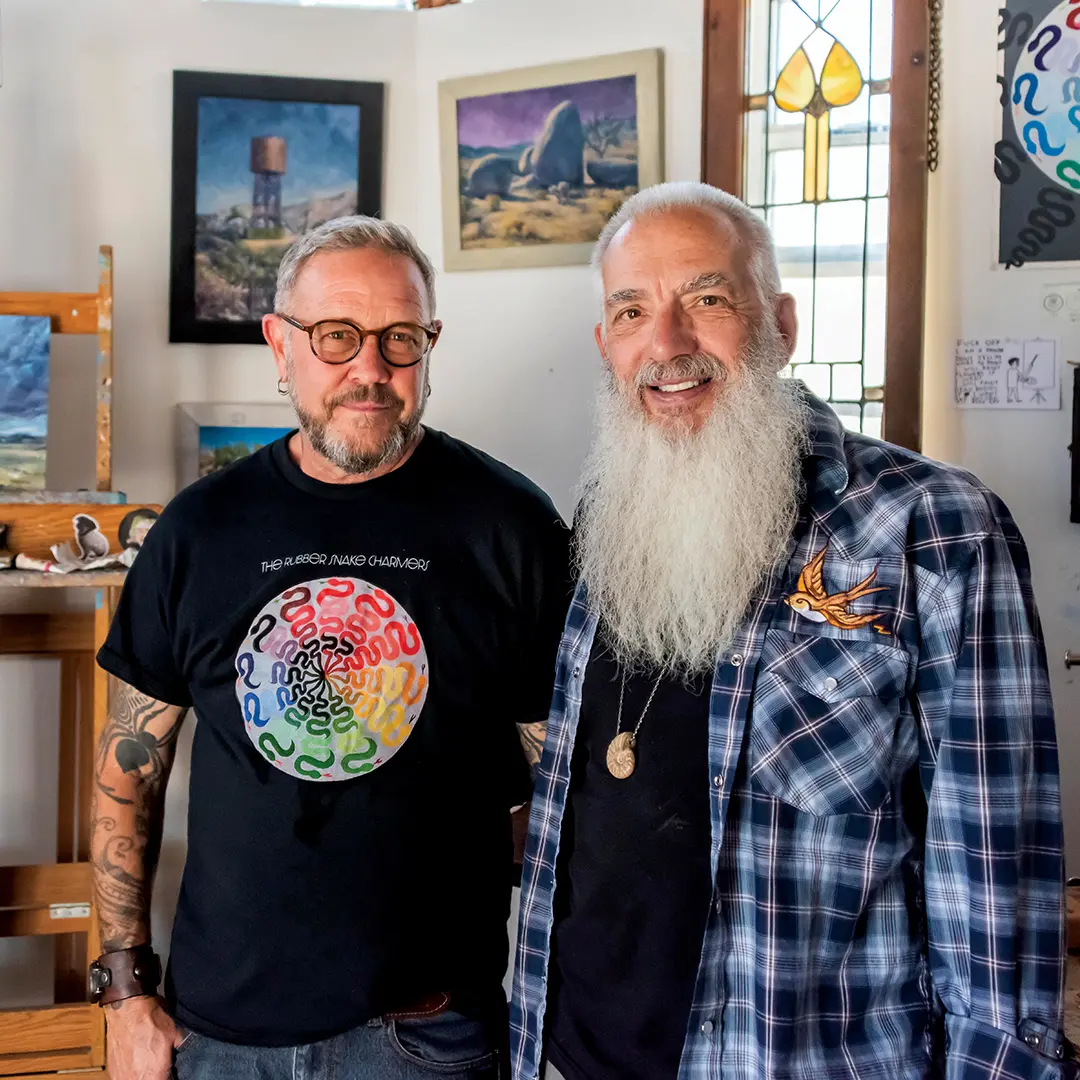
DAP Health’s Clay Cross and his artist husband Steven Wybenga in Wybenga’s home studio.