

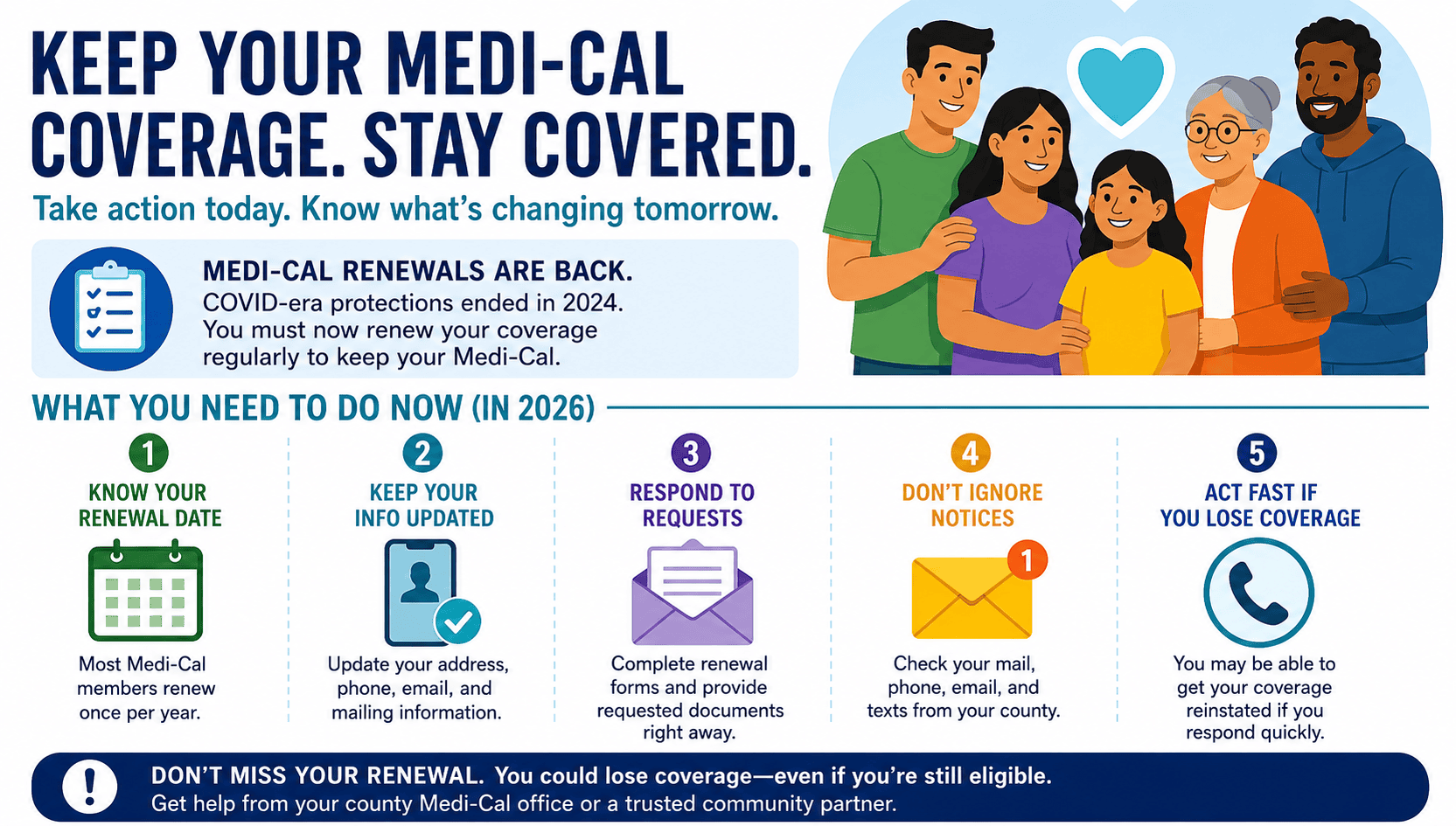
Everything you need to know to ensure you remain in care.
The COVID-era continuous coverage protections ended in 2024, and California has returned to regular eligibility renewals. As of January 1, 2026, Medi-Cal members must now:
- Open and respond to notices from their county Medi-Cal office, and complete renewal paperwork when requested
- Keep address, phone, email, and mailing information current
- Respond to county requests for income or eligibility verification
Failure to complete a renewal can result in loss of coverage — even if you are still eligible. California continues to use automatic (“ex parte”) renewals whenever possible, but many members still receive renewal packets requiring action.
What Patients Need To Do Right Now
1. Know your renewal date
Most Medi-Cal members renew once per year in 2026.
2. Update your contact information
Counties send notices by mail, phone, text, and email. If contact information is outdated, members may miss deadlines and lose coverage.
3. Complete renewal requests immediately
Return forms and requested documents as soon as possible.
4. If coverage ends, act quickly
Many individuals can have coverage restored if they respond promptly after a termination notice. Some immigrant populations receive a three-month grace period to reenroll before having to submit a new application.
Major Medi-Cal Changes in 2026
January 1, 2026: Asset Tests Return for Some Populations
California reinstated asset limits for certain Medi-Cal programs serving:
- Adults age 65+
- People with disabilities
- People receiving long-term care services
Current limits are:
- $130,000 for one person
- Plus $65,000 for each additional household member
Income rules are not changing. Assets are reviewed during renewal.
January 1, 2026: Enrollment Freeze for Some Undocumented Adults
Adults age 19+ without qualifying immigration status can no longer newly enroll in full-scope Medi-Cal.
However:
- Existing enrollees can remain covered
- Children remain eligible
- Pregnant individuals remain eligible
- Current members who renew on time can keep coverage
This is one of the most misunderstood changes. It is not a mass termination of existing members.
Major Medi-Cal Changes in 2027
Several of the biggest federal Medicaid changes are scheduled to begin in 2027.
January 1, 2027: Work Requirements
Some adults ages 19-64 will be required to demonstrate:
- Employment
- Volunteer work
- School attendance
- Job training
Generally, the requirement equals approximately 80 hours per month. Many groups are exempt, including:
- Pregnant people
- People with disabilities
- Individuals with serious health conditions
- People with substance use disorders
- Many parents and caregivers
- Recent jail or prison releases
- Former foster youth under age 26
California is still awaiting some federal implementation guidance.
January 1, 2027: Renewals Every Six Months for Some Adults
Many adults covered through the Affordable Care Act expansion population will move from:
Annual renewal → Every six months
This is expected to affect millions of Californians and is one of the biggest administrative changes coming to Medi-Cal.
January 1, 2027: Less Retroactive Coverage
Historically, Medi-Cal could pay certain medical bills incurred before application.
Beginning in 2027:
- ACA expansion adults generally receive only one month of retroactive coverage
- Other Medi-Cal groups generally receive two months
This may leave some newly eligible patients responsible for more medical bills incurred before enrollment.
July 1, 2027: Dental Coverage Changes
Some adults without qualifying immigration status will lose full Medi-Cal dental benefits. Emergency dental services remain covered. Pregnant individuals and certain other protected groups continue receiving full dental coverage.
July 1, 2027: Monthly Premiums for Some Members
California plans to require some adults without qualifying immigration status to pay a monthly premium — currently projected at approximately $30 per month — to maintain full-scope Medi-Cal coverage.
Failure to pay could result in loss of full benefits and transition to more limited coverage.
Details may still evolve before implementation.
Key Messages
- Do not ignore Medi-Cal mail.
- Update your contact information immediately if it changes.
- Complete every renewal request on time.
- Ask for help if you receive a termination notice.
- Major new eligibility and renewal rules begin in 2027, so staying connected to your county Medi-Cal office is more important than ever.
One Caution
Some of the 2027 provisions — especially work requirements and six-month redeterminations — stem from federal changes that still require ongoing implementation guidance. The overall direction is clear, but operational details could continue to change before full rollout.
DAP Health is Here to Help
For assistance, please call 760.466.0800 and ask to speak with an enrollment specialist.